

Most people (clearly talking about non-marketers) associate marketing with being experts in choosing colours, creating presentations, and outsourcing creative tasks to creative agencies. But marketing is so much more than that. A big part of the job is using data to understand our consumers better and then having the skills to transform this into opportunities for the brand and the business. This is where creativity has the main role.
In the post “Creativity in Business” we discussed a methodology that is quite popular right now: Design Thinking, a methodology that encourages creativity through a decision-making process. But how and when can we use design thinking in marketing?
Design Thinking in Marketing
Design thinking as a problem-solving process can help marketers create fresh ideas, intriguing concepts, and find unique solutions to consumer’s unmet needs. Here are the design thinking steps and how they can be used in marketing.
Phases
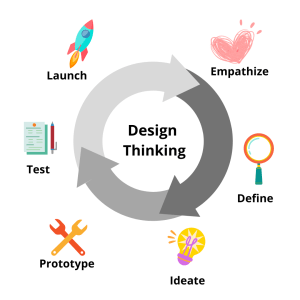
- Empathize to understand your consumers at an emotional level. This can be done by carrying out focus groups, surveys, reading consumer trends. During this stage it is necessary to leave all assumptions and expectations behind. Listen carefully to everything they have to say, you might find some useful information about something you weren’t looking for in the first place.
- Define your problem or what you’re trying to solve. Adopt a problem-solving attitude, review the information gathered, try to empathize with your consumers and identify their pain points and concerns. Instead of trying to solve their needs with your product, try thinking, what type of product would they need? During this stage you should develop a brief, this will help you define the problem and findings and to create consensus among all team members.
- Ideate! At this stage, you should have a deep understanding of your consumer and their problems. It’s now time to brainstorm for innovative ideas, no limits. It is extremely important to create a space where every idea is welcome, no matter how crazy it might seem. We’re trying to think of ideas out-of-the-box anyway, right?
Tools that can be used include: - Prototype your best ideas. Select one or two of your ideas (the ones that have the most potential) and bring them to life. At this point what you’re looking for is not for a perfect prototype, you want to test if your idea works as you thought it might. Test it out with a small group and see if they find it useful, easy to use, if it meets the needs you had in mind.
To keep in mind: you will likely (very likely) have to make several iterations until you have the final product, so make sure you have a prototype that works for getting feedback, but don’t try to make it perfect (this could end up very time-consuming and costly). - Test and get feedback from other humans. Once you have tested your prototype with a small group, it’s time to test with a larger group, and with your consumers. Testing will let you know if your product works.
Spoiler: Be prepared to start from scratch if the solution doesn’t work as expected. - Launch! Once you’ve gathered enough feedback, made all the necessary changes, you’re ready for launch. Well, first you’ll have to work on the marketing campaign.
Do you need some help? Look at our article: Creativity in Advertising
References & useful links
- Creativity & Innovation in Business, M. Davis, Brooke.
- IDEO
- How to use design thinking in marketing, MIT ID Innovation
- What is design thinking?, IDEO
- The Five Phases of Design Thinking, American Marketing Association
 The Creative
Leave a comment