

You might not have thought about it, but creativity is present in many aspects of our life. Have you ever had sticky hands while cooking and you found one of your child’s toys that had just the right shape to hold up your phone? This is creative thinking!
How about at work?
Innovation is they key to success for today’s business. You might be familiar with the term “design thinking” as part of the innovation process at your company. Design thinking is a methodology that encourages creativity through a decision making process. It helps teams bring unique ideas to the table through a guided process, ensuring that these ideas will increase the firm’s value offerings.
Design Thinking
Design thinking is mostly used for product development, but can also be used for designing the marketing strategy as well as in other business areas.
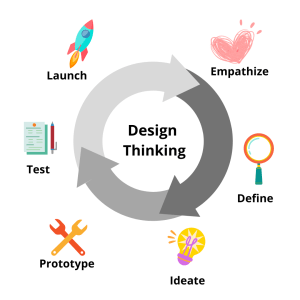
Global business like P&G have recognized that design thinking needs to be integrated into the innovation process and corporate structure with the help of IDEO, a global design firm that takes a human-centered, design-based approach to help organizations innovate and grow.
Dow Corning is another example of a business who has take actions towards a design thinking oriented culture to help bridge the hap between scientists and designers.
Steps
- Empathize by gathering high-quality consumer understanding. Try to fully understand your consumer or client. This includes understanding their needs, barriers, attitudes, and aspirations. At this point, it’s highly important to leave expectations and assumptions aside.
- Define your problem or what you’re trying to solve. You can try asking yourself questions like, what are the unmet needs? What problems do our customers have? Do we need to reassess our assumptions? During this stage you should develop a brief (especially speaking to marketers), to define the problem and findings. Briefs are important for guidance and to create consensus among all team members.
- Ideate. Once you have a deep understanding of the consumer (or client), as well as a solid definition of the problem to solve, you can now start thinking of your solution. Different tools that can be used at this stage can include, brainstorming, mind-mapping, or sticky notes. The most important thing is to create the right space for divergent thinking to occur.
- Prototype your best solutions. Select a couple of your ideas (the ones that have the most potential) and bring them to life. Hold design sprints, rapid-sketch sessions, try anything you like. Remember: perfection is not important at this stage, what you’re looking for is to get feedback as fast as possible and iterate your product to get it closer to the final version.
- Test and get feedback from other humans. Let your consumers test it out and tell you if it’s something that is intuitive, easy to use, and most importantly. Does it solve the problem you were trying to solve? Gather as much feedback as possible.
- Launch! Once you’ve gathered enough feedback, made all the necessary changes, you’re ready for launch. Well, first you’ll have to work on the marketing campaign.
References & useful links
- Creativity & Innovation in Business, M. Davis, Brooke.
- IDEO
- How to use design thinking in marketing, MIT ID Innovation
- What is design thinking?, IDEO
- The Five Phases of Design Thinking, American Marketing Association
 The Creative
Leave a comment